
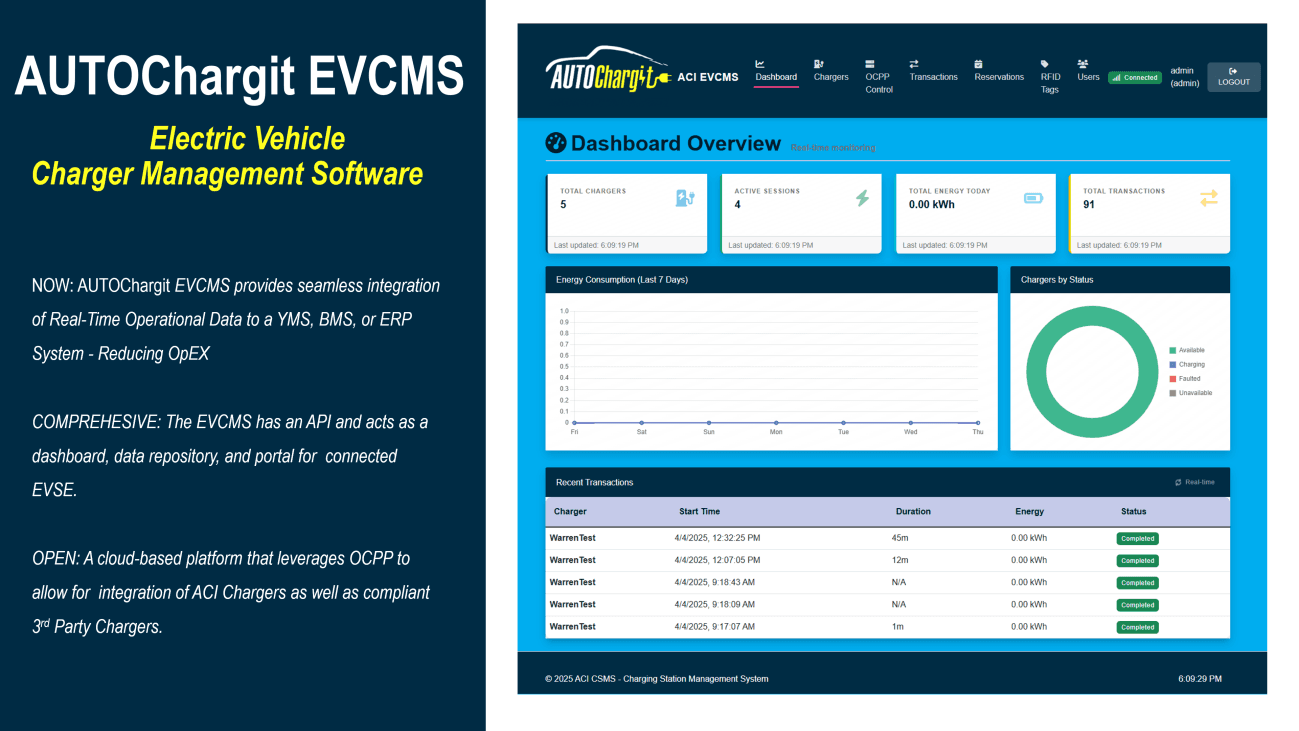
Cloud-Based Software Supports OCPP Compliant Chargers
At AUTOChargit, we promote three key ingredients for the successful operation of an EV charging solution.
- DO NOT overcapitalize. Far too often, we are alerted to cautionary tales of developers who installed EV Supply Equipment (EVSE) only to find out the market was non-existent or never materialized.
- Regardless of the number of EVSE installed, charge for every charge. Do not give electricity away for free. It sets a bad precedent, and it is difficult to turn back.
- Expand based on metrics. Be data-driven, not emotional.
As AUTOChargit’s (ACI) product roadmap for Stationary, Switching, Mobile, or Automated continues to expand to meet market demands, one product has emerged as paramount to track Overall Equipment Efficiency (OEE) for each EV Charging Station as ACI’s EV Charge Management System (EVCMS).
ACI EVCMS provides seamless integration of Real-Time Operational Data to a YMS, BMS, or ERP System, reducing OpEX with needless service calls. The EVCMS has an API and acts as a dashboard, data repository, and portal for connected EVSE. This allows for immediate status updates, tracking usage, and revenue generation. A cloud-based platform that leverages OCPP to allow for integration of ACI Chargers as well as compliant 3rd Party Chargers. Systems that grow over time can leverage multiple vendors but still require a single pane of glass.
“You cannot control what you do not measure.”
NOTE: EVCMS is based on OCPP version 2.1, and EV Chargers need to be OCPP Compliant with 2.0.1 or later. OCPP Version 2.1 allows EVCMS to remotely control, configure, and collect an EVSE. Below is a quick summary of the historical features of the Open Charge Point Protocol.
OCPP 1.5 (2012)
- Based on SOAP/XML only
- Introduced remote management, dynamic load management, basic diagnostics, firmware updates, and reservation capability
- Lacked a standardized certification process; multiple vendor implementations varied
OCPP 1.6 (2015)
- Added support for both SOAP and JSON over WebSockets
- Introduced basic Smart Charging with load-balancing through static charge profiles
- Enabled local authorization lists, reservation, firmware management, “trigger message” diagnostics, and status notifications
- Lacked strong security: reliance on TLS or custom VPN/IPsec for encryption
- Widely certified and deployed—seen as mature and stable
OCPP 2.0 (2018)
- Transitioned to JSON-only WebSocket; dropped SOAP/XML
- Introduced a hierarchical model: Charging Station → EVSE → Connector, replacing the flat connector-only approach
- Merged transaction messages into a single TransactionEvent; added WebSocket compression
- Embedded stronger cybersecurity features: TLS security profiles and certificate handling
- Enhanced Smart Charging: recurring schedules, dynamic updates, integration with ISO 15118, and support for V2G
- Added device management, aggregate schedules, diagnostics, EVSE-level control, and display messaging
- Not backward compatible with OCPP 1.x
OCPP 2.0.1 (2020)
- Refined and bug-fixed 2.0, restoring structure and clarity
- Maintained hierarchical EVSE/connector model, unified TransactionEvent, and WebSocket compression
- Full security overhaul: data-level encryption, certificate auth, secure firmware, logging
- Smart Charging improved with EV-expressed energy needs (kWh), grid-friendliness, and schedule flexibility
- Integrated ISO 15118 for Plug & Charge and enhanced V2G readiness
- Features centralized device manageability, display messages, transaction resilience in reconnects
- Not backward compatible with 1.6; certification available since 2023
- Adoption: growing; expected to be mainstream by late 2025 as vendors support both 1.6 & 2.0.1
OCPP 2.1 (2025)
- Built on 2.0.1 while maintaining compatibility
- Adds:
- ISO 15118-20 V2X and bidirectional energy transfer
- DER control block (coordination with local distributed energy resources)
- Smarter Smart Charging, improved schedules, and resume after reboot
- Battery swapping support
- Local cost calculation, prepaid cards, and dynamic QR for ad hoc payment
- Prepaid and new authorization modes, local cost handling
- Additional improvements based on community feedback
For more information, see www.AUTOChargit.com or contact Shawn Adams at: sadams@dasherlawless.com